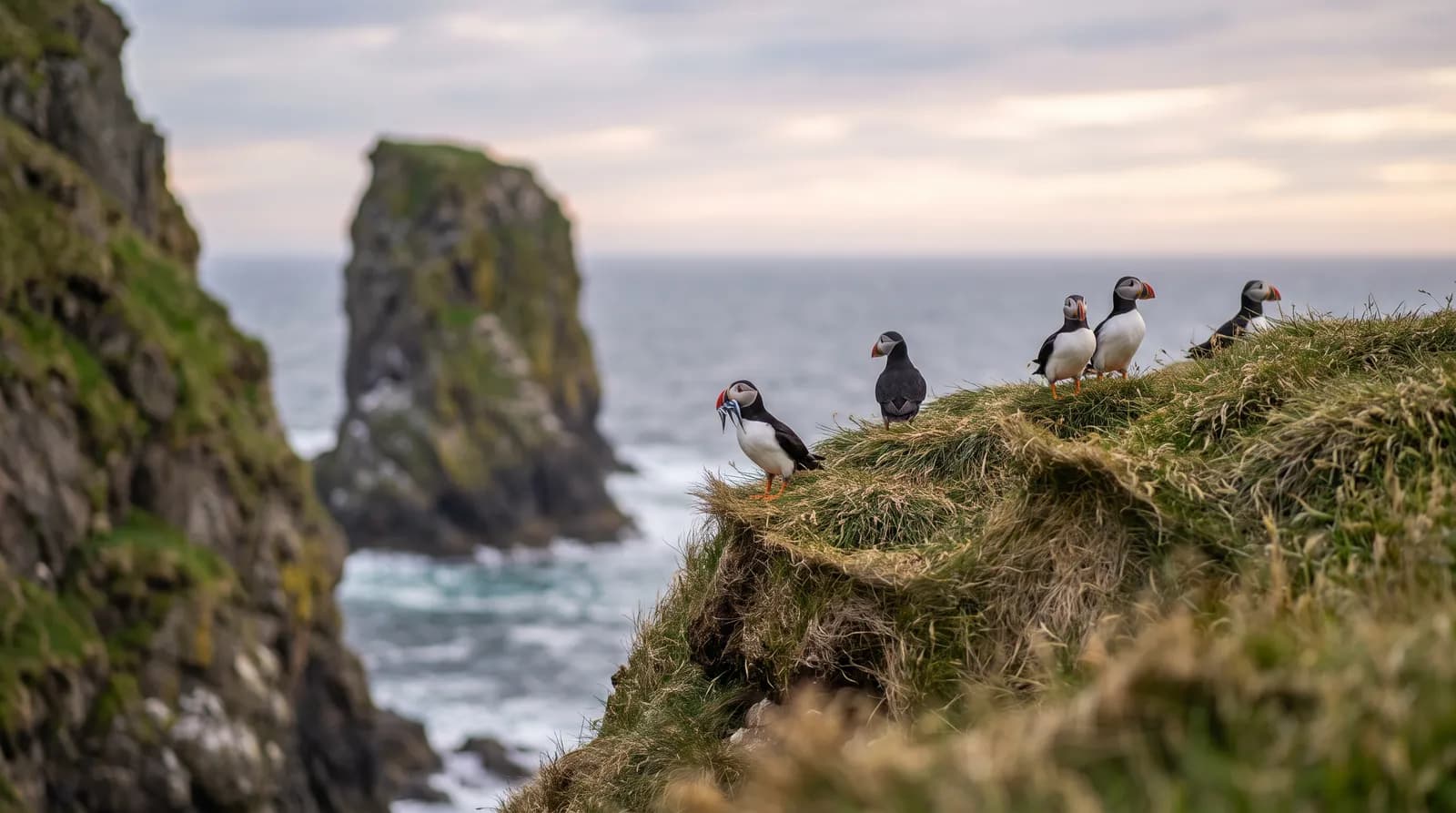
When puffins are here
Puffins spend most of the year at sea and only come to land to breed. In Newfoundland they are generally present at their colonies from around May into early or mid September. The town of Elliston says its puffins usually return in May and stay until about the end of September.
Within that window, June through August is the most reliable. Activity often picks up when capelin come inshore, usually around mid-June or July, as the adults ferry fish back to their burrows. Exact timing shifts from year to year.
Witless Bay Ecological Reserve (by boat)
The Witless Bay Ecological Reserve, in the Avalon region, is made up of four islands a few kilometres offshore between Bay Bulls and Bauline East, about half an hour south of St. John's. The provincial government describes it as home to North America's largest Atlantic puffin colony, with more than 260,000 pairs, along with large numbers of kittiwakes, common murres and Leach's storm-petrels.
What to know:
- You see it by boat. Public landing on the islands is not allowed. Viewing is from licensed tour boats or, for experienced paddlers, kayaks that stay outside set distances from shore.
- Several licensed operators run tours from Bay Bulls and nearby communities, including O'Brien's Boat Tours. Tours often combine puffins with whales and, early in the season, icebergs.
- It is close to St. John's, which makes it an easy half-day trip even on a short visit.
Elliston (from land)
Elliston, on the Bonavista Peninsula in the Eastern region, has a well-known land-based puffin viewing site. Puffins nest on a small island just off the cliffs, close enough to watch without a boat.
- Access: a short walk, a few minutes, from parking near the main road. The viewing area is free; donations are generally welcome.
- Distance: the birds on the island are a short distance across a narrow gap, so how close they come varies. Some days they land on the near side; other days you watch from across the water. Patience usually pays off.
- Timing: early morning and late afternoon are often more active and less busy.
- Stay back from the edge. The cliffs are high, exposed and windy. Keep to the paths, and don't walk on the burrows.
Cape Bonavista
A few minutes from the town of Bonavista, the Cape Bonavista lighthouse area also has puffins nesting in the grassy slopes nearby. It pairs easily with Elliston on the same day. For a base, see Russeltown Inn in Bonavista and other options under lodging.
Cape St. Mary's Ecological Reserve
Cape St. Mary's, in the south-west of the Avalon about 200 km from St. John's (roughly two and a half hours' drive), is famous for seabirds, but it is not primarily a puffin site. The main sight is Bird Rock, a sea stack covered in nesting northern gannets that you can view at close range from the mainland cliff. You will also see murres, kittiwakes and razorbills. Puffins are present only in small numbers.
- The walk from the interpretation centre to the main viewpoint is about 1.4 km each way, roughly 20 to 30 minutes.
- The interpretation centre is open seasonally, generally May to October. Check current hours with the reserve before you go.
- Fog is common, especially in early summer. Bring warm, windproof layers.
Go here for gannets and the scale of the colony, and go to Witless Bay or Elliston for puffins.
Other places
Puffins nest in smaller colonies elsewhere in the province, including islands off the Great Northern Peninsula in the Western region, where boat tours run from some communities in summer. Ask locally about current options.
Tips for puffin watching
- Bring binoculars and, if you take photos, a longer lens.
- Dress for wind and fog, even in July.
- Don't approach burrows or chase birds. Puffins nest underground and are easily disturbed.
- Weather cancels boat trips, so give yourself a backup day if Witless Bay is a must.
Plan it
Browse boat tours and tours and guides, or use the trip planner to contact operators. Puffins overlap with whale season; see whale watching in Newfoundland.